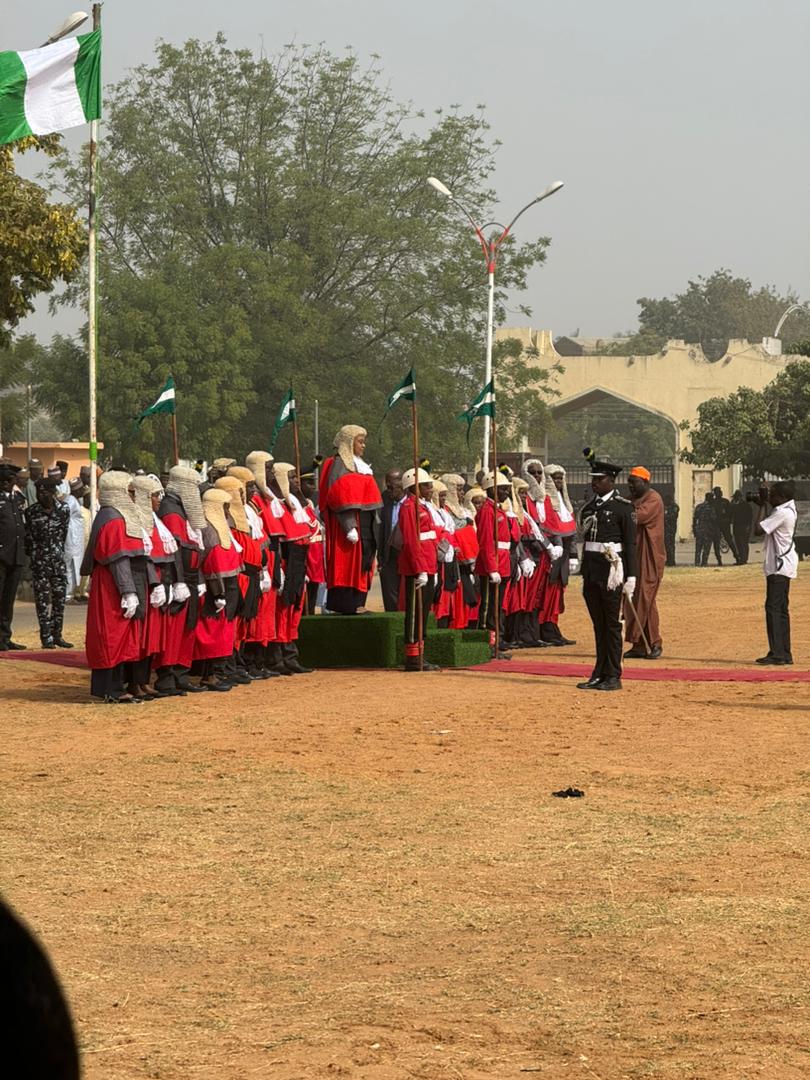
The Kano State High Court of Justice as a segment of the State Judiciary come into being in the year 1968, a year after the creation of Kano State out of the defunct Northern Region of Nigeria. Kano was one of the twelve states created during the Military Administration of the General Yakubu Gowon (Rtd) in 1967. Prior to the establishment of the State High Court, the existing High Court was that of the Northern Nigeria with one of its Judicial Divisions located in Kano. The Kano Division had two resident Hon. Judges of the High Court in person of Hon. Justice Holdings and Hon. Justice Wheeler, the former being previously a puisne Judge. Hon. justice Williams was earlier on appointed to oversee Kano and Sokoto Divisions before the eventual posting of the two resident Judges.
In the year 1970 when Hon. Justice Holdings was transferred from the Kano High Court, Justice J.R. Jones was posted to take over from him as a Senior Puisne Judge. During his tenure in office, he established a Magistrates’ Court in Gumel, being the first Magistrate Court to be sited outside Kano city. Other Magistrates’ Courts to be established outside the city were those of Hadejia and Birnin Kudu, which are now within Jigawa State.
In view of the increasing commercial activities and population, the need was felt to appoint more judges of the High Court. Therefore, around the year 1970, two additional Judges of the High Court were appointed. They were Hon. Justice Abubakar Bashir and Hon. Justice Sani Aikawa of blessed memories. The Hon. Justice Abubakar Bashir Was appointed the Acting Chief Registrar/Commissioner for Area Courts .He was also appointed a Kadi of the Sharia Court of Appeal/Judge of the High Court as well. When His Lordship clocked ten years at the Bar, he became the first native judge to be appointed to the Kano State High Court Bench.
In 1976 Hon. Justice A.B Wali was seconded to the Executive arm and became the second Attorney- General of the State. As years passed by and dockets of the Hon. Judges increased, more and more judges were appointed to the high bench. The office of the Chief Registrar was later separated from that of the Commissioner for Area Courts which was redesignated as the office of the Chief Inspector. Both officers were directly answerable to the Senior Puisne Judge.
Hon. Justice J.R. Jones was appointed the first Chief Justice of Kano, the title that was later changed to the Chief Judge of Kano State. Among the notable judges who were serving on the Kano State High Court Bench were the Hon. Justices Umar Kalgo, Umaru Maidamma, Layiola Nwabueze and Fernandez.
The year 1976 saw the appointment of the first female High Court Judqe in the whole of the Northern Region of Nigeria, in person of Hon. Justice Aloma Maryam Mukhtar, when Hon. Justice J.R. Jones retired in 1979, the first indigenous Chief Judge in person of Hon Justice Dahiru Mustapher was appointed. During his tenure, the present High Court Complex situated along the State road, was Commissioned and occupied. On the elevation of the Hon. Justice Dahiru Mustapner to the Court of appeal, another indigene of Kano State in the person of Justice sale Umar Minjibir became the Chief Judge in 1985. The number of High Court Judges rose to fifteen (15), while the Area Court judges increased to One Hundred and Ten(110), and Magistrates’ Courts were established in most of the Local Government Headquarters.
Hon Justice Sale Umar Minjibir was the first to celebrate a Legal year in September1989, and the legal tradition continues up to today. His Lordship, Hon. Justice Sale Umar Minjibir retired on the 31st March, 2000 and Hon. Justice Saka Yusuf was appointed the Acting Chief Judge.
During the early phase of the fourth Republic, there was a widespread agitation for the implementation of the Sharia Legal system in the twelve Northern States in Nigeria, which brought about the enactment of the Sharia Law legislation in the States. Hence the Sharia Legal system became fully entrenched in the justice system in Kano State. In line with the provisions of the Law, the nomenclature of the then Area Courts was changed to Sharia Courts and the administrative control of the Sharia Courts was placed under the supervision of the Hon. Grand Kadi of the Sharia Court of Appeal.
In June 2001, Hon. Justice Sanusi Chiroma Yusuf was appointed the Chief Judge of Kano State. The various policies initiated and formulated by him were implemented at all departments of the High Court through the Chief Registrar and with the help of other senior administrative and legal officers. A number of in frastructural developments were recorded under him, which include construction of more Court Complexes, purchase of official vehicles, review of salaries and allowances, etc. The foundation of the permanent site of the Judicial Service Commission was also laid at the Audu Bako Secretariat, Kano. The independence of the Kano State judiciary was promoted and maintained under his stewardship which had immensely contributed towards the improvement of welfare the Judiciary staff.
The tenure of Hon. Justice S.C. Yusuf as Chief Judge of the State witnessed a landmark achievement in the increase in number of the High Court Judges, which rose from seven to nineteen Judges. In the year 2016, he placed the Court on the information technology phase, where High Courts/Magistrates’ Courts Complexes were rehabilitated and fully equipped with computers and other ICT working materials. In his resolve to decongest the Over-burdened courts and provide a faster and more cost effective means of dispute resolution, His Lordship eagerly emhraced the idea of Alternative Dispute Resolution,
(ADR) under the auspices of the Department for International Aid (DFID) and immediately set up a steering committee headed by late Justice Muhammad Halliru Abdullahí to formalize the process of Kano State Multi-Door Court House (KMDC) take-off. The KMDC was conceived to be a dispute resolution centre with the capability of setting civil matters using ADR mechanisms, which include arbitration, mediation, conciliation and other hybrid processes. The ADR process is recognized by the provision of the Arbitration and Conciliation Act, 2000. The KMDC is an additional door to justice and justice is the firmest pillar of every successful society. The idea is to save time and money for both disputing parties and the court, while also improving satisfaction with the process.
After the voluntary retirement from office of the then Chief Judge, Hon. Justice Sanusi Chiroma Yusuf Hon. Justice Shehu Atiku was appointed into the exalted office and sworn in on the 31st March, 2008. During the period, the Kano State Judiciary and in particular the High Court of Justice witnessed rapid development and expansion in terms of infrastructure, capacity building of various categories of staff as well as appointment of Magistrates and Judicial officers. Pursuant to the noble inspiration of establishing the KMDC, His Lordship, Hon. Justice Shehu Atiku signed a Legal Notice which provided for the establishment of the Kano Multi-Door Court House. The inauguration of the KMDC took place on the 20th January, 2009 followed by the constitution of the membership of its Governing Council as well as its principal officers.
In a bid to bring justice closer to the people, five Divisional High Courts were created for the first time at Danbatta, Gaya, Gwarzo, Rano and Tudun Wada Judicial Divisions respectively. In the same vein, by an order dated the 3rd of November, 2010, His Excellency the Executive Governor of Kano State dissolved the Rent Tribunal and transferred their functions to Magistrates’ Courts. This has further broadened the jurisdiction of the Magistrates’ Courts, and the objective was to bring the Rent Control Edict of 1997 into conformity with the provisions of the 1999 Constitution. Later, four (4) additional High Courts were created namely; Bichi, Wudil, Gezawa and Ungogo respectively. Under the períod of his stewardship, twenty six (26) Magistrates’ Courts were newly constructed and commissioned on the 7th May, 2013. The same was extended to Sharia Court Department where twenty seven (27) Sharia Courts were constructed. Flowing from the creation of additional Divisional High Court, six (6) judicial officers were appointed and subsequently sworn-in on 11th February, 2009. It is noteworthy that with the increase in number of cases filed in courts, coupled with the expansion of courtrooms in the State, four (4) more Judges were appointed to bring the number to twenty four (24) Judges on the 30th October 2013.
In an effort to streamline the laws and procedures, the judiciary under the leadership of the Hon. Justice Shehu Atiku facilitated the reform of obsolete laws and procedures. A number of practice directions were provided to serve as a supplement to the High Court civil procedure rules of 1988. The 1988 civil procedure was later to be replaced with the kano state civil procedure 2014.
On the retirement of Hon, justice Shehu Atiku, on the 7th January, 2015 Hon. Justice P A Mahmoud was sworn in as the acting chief judge for six months, before Hon justice Nura Sagir Umar was sworn in as the acting chief judge on the 10th July, 2015. His tenure witnessed a lot of remarkable achievements in the area of law review and appointment of lower court judges. Magistrates court law which has been in existence since 1987 was repealed and new one came into effect on the 25th of April, 2018. To supplement the magistrates’ court rules, a practice direction on small claims courts was also provided. Its core objective is to provide easy access and speedy resolution of simple debts recovery.
As an organization, the high court is faced with some challenges, to mention a few, the challenges are more pronounced in terms of human resources, such as insufficient number of high court judges to man the higher bench. By January 2013, the number of high court judges serving on the higher bench was twenty four (24), which number has however, presently dropped to seventeen (17). The drop in the number was to death, retirement, or elevation to court of appeal, which has drastically resulted in unbearable backlog of cases tried by the Hon. Judges, so much so that the judges are overworked in a bid to cope with the situation.
Another challenge though currently being addressed is lack of capacity building and training of staff. The high court has currently embarked on training and capacity building of staff and officers at all levels. Even, recently a five day judicial retreat had been conducted for all judicial officers, magistrates, sharia court judges, management and other principal officers of the kano state judiciary with a view to expanding their overall knowledge and improving their capacity building.
Another challenge that needs to be urgently addressed is insufficiency of courts and office accommodations’, which leads to the sharing of courts facilities by Hon. Judges and magistrates in most of the complexes. Where these facilities exist, they are in most cases in dilapidated conditions. The issue of welfare of staff is another critical challenge bedeviling the smooth administration of justice, and in an attempt to tackle the problem, kano state judiciary had in 2022 forwarded a bill on improved condition of service of the judiciary staff to the state house of assembly, which had already been passed by the honorable members, but not yet assented to by the executive. The issue of corruption is yet another distressing challenge militating against the well-being of the judiciary.
Despite all the challenges, some of which have not been mentioned, the judiciary is now committed to providing a new sense of direction and enabling environment. The judiciary has under the able administration of Hon. Chief Registrar Alh Abdullahi Ado Bayero of the high court of justice, issued out a vision and mission statement aimed at coming up with a practical blueprint to serve as a working document for achieving the overall development and growth of the judiciary.